

The last time a major power discovered a resource this strategically important in a territory this contested, we called it the Scramble for Africa — and it reshaped the world for 150 years. Right now, in the craters of the Moon’s south pole, something similar is beginning. It’s quieter. It’s slower. And almost nobody outside aerospace policy circles is paying attention to it yet.
Which is exactly why you should be.
Lunar water ice, found in the permanently shadowed craters of the Moon’s south pole, can be split into hydrogen and oxygen — the components of rocket fuel. Whoever controls this resource controls the refueling infrastructure for the entire solar system, making it far more strategically valuable than oil ever was on Earth.
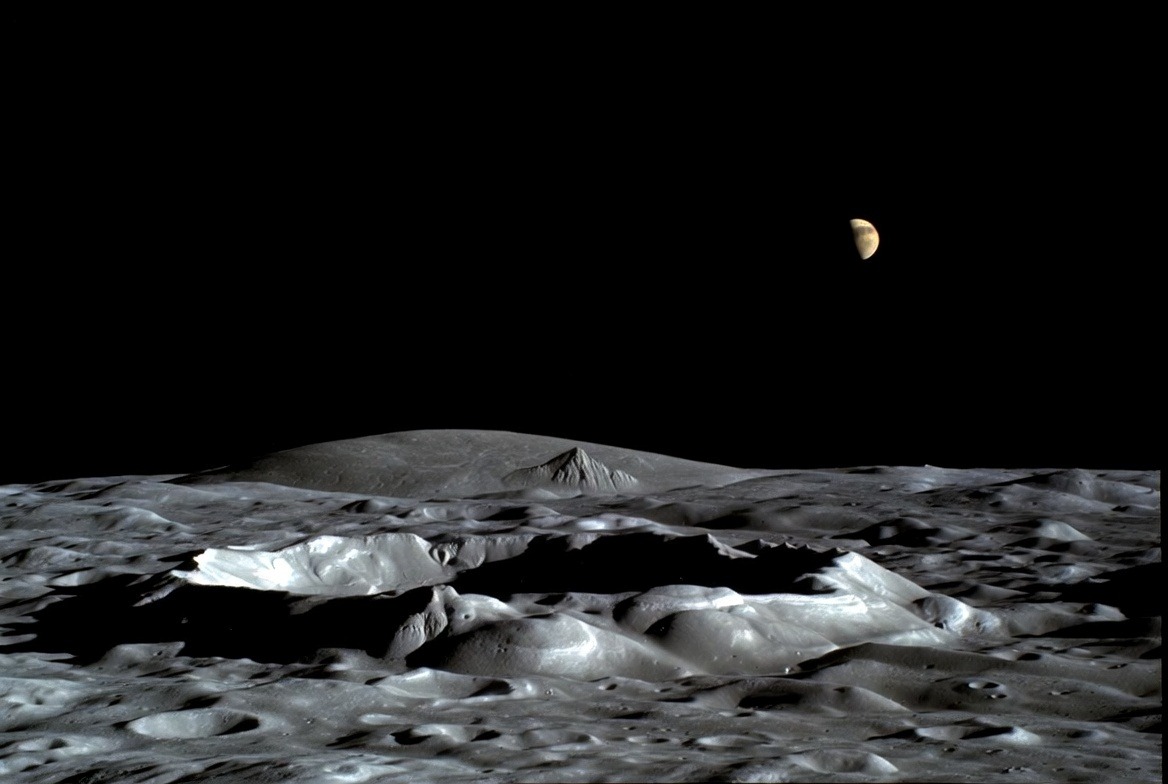 Caption: The Moon’s south pole — the permanently shadowed craters here hold water ice worth more, strategically, than any oil field on Earth.
The Thing Hiding in the Shadows
Here’s what makes the Moon’s south pole different from everything else up there. Certain craters near the poles are tilted at such an angle that sunlight never reaches their floors. Not once in billions of years. These permanently shadowed regions — PSRs, in NASA shorthand — sit at temperatures approaching minus 250 degrees Celsius. Cold enough that water ice deposited by ancient comets and asteroids has simply never melted, never sublimated, never gone anywhere. It’s been sitting there, frozen in the dark, for geological timescales.
NASA’s LCROSS mission confirmed the presence of water ice at the south pole in 2009. India’s Chandrayaan-1 provided additional evidence. The question is no longer whether the ice exists. The question is how much of it there is, how accessible it is, and — most urgently — who gets there first.
Water does something on the Moon that it has never done on Earth: it becomes rocket fuel. Run an electrical current through H₂O and you split it into hydrogen and oxygen. Those two elements, when stored cryogenically and ignited, are among the most powerful propellants in rocketry. The Space Shuttle’s main engines ran on them. The Artemis program’s SLS rocket runs on them. The energy cost of lifting rocket fuel off Earth is enormous — so enormous that it represents the single largest economic barrier to deep space exploration. Lunar water eliminates that barrier. Completely.
Why ‘Rocket Fuel’ Doesn’t Capture How Big This Is
Think of it this way. Every ship that crossed the Atlantic in the age of exploration needed to carry enough food, water, and fuel for the return journey. That constraint — the need to carry everything you needed from the start — defined the entire economics of exploration. You could only go as far as your cargo hold allowed.
Lunar water ice breaks that constraint for space travel the same way the discovery of mid-ocean islands broke it for maritime exploration. A refueling station on the Moon — using water ice converted to hydrogen and oxygen — means spacecraft traveling to Mars, the asteroid belt, or the outer planets don’t need to haul all their propellant from Earth. They stop and refuel. The economics of the entire solar system change. The Moon doesn’t just become strategically important. It becomes the choke point through which all serious deep-space activity must pass.
That’s why the water matters. Not for drinking. Not even primarily for life support. For propellant. Whoever builds and controls refueling infrastructure at the lunar south pole holds a position analogous to whoever controlled the Suez Canal in the 19th century — except the territory at stake isn’t a strip of Egyptian desert. It’s access to the rest of the solar system.
 Caption: From crater to rocket engine: the lunar water ice extraction and propellant production pipeline that makes the Moon the solar system’s first gas station.
Artemis II Just Happened. Here’s What Nobody Said Out Loud.
On April 10, 2026, four astronauts splashed down off the coast of San Diego after completing the farthest human spaceflight in 54 years. NASA’s Artemis II mission flew them 252,756 miles from Earth — farther than any human since the Apollo 13 crew in 1970 — around the Moon and back, in a test of the Orion spacecraft’s deep-space systems.
It was a genuine triumph. The coverage was celebratory. Speeches were made. The astronauts were heroes, and rightly so. But underneath the flags and the press conferences, there was a number that barely made the headlines: the lunar landers needed for Artemis III — the mission that will actually put people on the surface — are behind schedule. NASA’s own Inspector General has warned that the timeline to land humans on the Moon by 2028 is at risk.
And while NASA was celebrating Artemis II’s success, China was quietly finalizing its Chang’e 7 mission, scheduled to launch in mid-2026. The destination: the lunar south pole. The explicit objective: to search for and characterize water ice deposits in the permanently shadowed regions. Chang’e 7 carries an orbiter, a lander, a rover, and a small flying hopper — a vehicle specifically designed to jump into the shadowed craters and gather data that no robot has ever collected. China is not planning a flyby. It is going for the ice.
Artemis II was a beautiful, historic test flight. But it did not land anyone on the south pole. Chang’e 7 might get close first. The race is not as comfortable as the press coverage suggested.
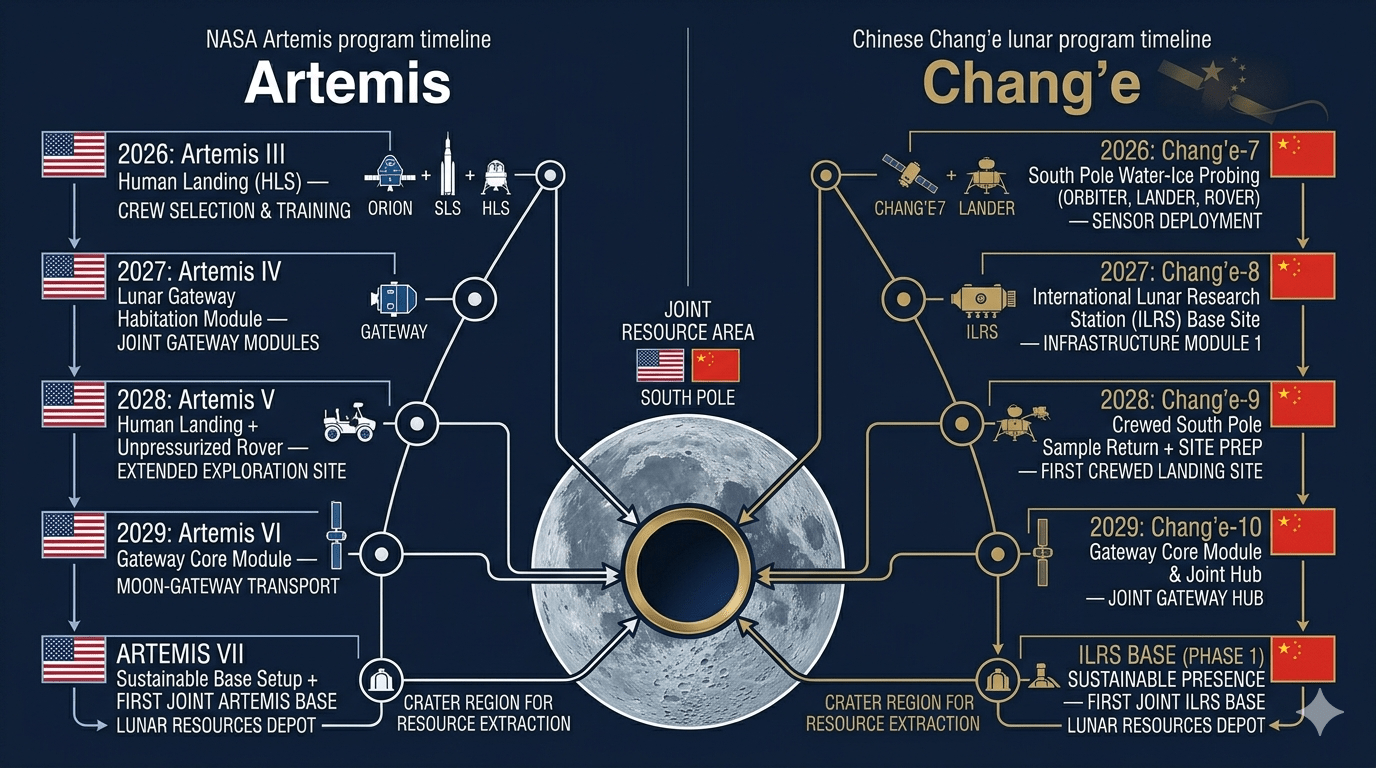 Caption: Two timelines, one destination: NASA’s Artemis and China’s Chang’e programs are both targeting the Moon’s south pole water ice — and the race is closer than most Americans realize.
SpaceX Gave Up on Mars. That Tells You Everything.
In 2025, Elon Musk declared that going to the Moon was a distraction. SpaceX was going straight to Mars, he said. The Moon was the wrong goal. Then, in late 2025 and into early 2026, something changed. Musk began talking about a self-growing city on the Moon. SpaceX quietly deprioritized its uncrewed Mars mission — delayed partly due to Starship technical issues, partly due to launch window constraints. The company that spent a decade defining its purpose as getting humanity to Mars is now focused, operationally, on the Moon.
Why? The short answer is that the Moon makes economic sense in a way Mars currently cannot. Earth-Moon commerce is a real, near-term business. Earth-Mars commerce requires six-to-nine-month transit times, narrow launch windows every 26 months, and no guarantee of a return market. The Moon, by contrast, is three days away. You can fix things that go wrong. You can ship things back. And if you control the refueling infrastructure there, every other actor in the commercial space economy has to deal with you.
Musk also floated the concept of a lunar mass driver — essentially a giant electromagnetic catapult on the surface of the Moon, capable of launching payloads into space without rocket engines. The economics of that are staggering. But mass drivers require sustained surface power. Which is exactly why NASA’s announcement of a fission surface power reactor for the Moon — planned for deployment by 2030 — matters beyond the engineering headlines. It’s the infrastructure layer that makes everything else possible.
The Fission Reactor Nobody Is Talking About
Nuclear fission surface power is not science fiction. It is an engineering program with a budget, a timeline, and a program executive. NASA’s plan is to deploy a compact fission reactor on the lunar surface that generates enough electricity to power a sustained human presence through the lunar night — the two-week period when the Sun disappears and solar panels become useless. Without continuous power, no lunar base is viable. With it, operations can run year-round.
Lockheed Martin is developing this technology. The program is called Fission Surface Power (FSP). It sits alongside nuclear thermal and nuclear electrical propulsion development that could eventually dramatically shorten travel times to Mars and beyond. The key point is this: whoever puts this infrastructure on the lunar surface first creates facts on the ground — the space equivalent of planting a flag that is also a power grid, a fuel depot, and a manufacturing base. Once that infrastructure exists, the geopolitical cost of displacing it becomes enormous.
|
Resource |
Location |
Strategic Value |
Who Controls It Now |
|
Persian Gulf Oil |
Middle East |
Earth’s energy economy |
OPEC + US interests |
|
Lunar Water Ice |
Moon’s south pole craters |
Entire solar system’s fuel supply |
Contested — race ongoing in 2026 |
|
Helium-3 (Lunar regolith) |
Moon’s surface soil |
Fusion energy (future) |
Unclaimed — geopolitical wildcard |
|
Orbital slots (near-Moon) |
Cislunar space |
Communication, surveillance, defense |
Rapidly being claimed |
Table: The Moon’s strategic resources compared to Earth’s most contested commodities.
The Legal No-Man’s Land 240,000 Miles Up
Here’s the part that should unsettle you. There is no clear legal framework governing who can extract, own, or profit from lunar resources. The 1967 Outer Space Treaty — signed by the US, USSR, and over a hundred other nations — established that no country can claim sovereignty over the Moon. But it says nothing unambiguous about whether private entities or nations can extract and sell resources found there.
The US drew its own line in 2015 with the Commercial Space Launch Competitiveness Act, which asserted that American citizens and companies can legally own resources they extract from celestial bodies — even if they can’t own the body itself. Luxembourg passed similar legislation in 2017. China has not publicly acknowledged this interpretation, and has been notably silent about whether it considers such claims legitimate under international law.
Think of it as the Law of the Sea problem, rerun in space. The Law of the Sea took decades of negotiation to produce a framework for who owns the ocean floor, who can fish in which waters, and how disputes get resolved. Space hasn’t had that negotiation yet. We are operating on a 1967 treaty written for a world in which only two nations were capable of spaceflight, in an era when nobody seriously believed resource extraction from the Moon was a near-term possibility. That treaty is not fit for purpose in 2026. And in the absence of an updated legal framework, the relevant precedent is not international law. It’s possession.
What ‘First Mover’ Actually Means in Space
Possession in space doesn’t mean planting a flag and walking away. It means building infrastructure. A water extraction facility. A power plant. A landing pad. A communications relay. Once these structures exist and are actively operating, the practical cost of displacing them — even without a legal basis for ownership — is enormous. Nobody is going to destroy a functioning lunar base. The political and military consequences would be without precedent.
This is what NASA Administrator Jared Isaacman meant when he told the Senate: ‘If we fall behind, if we make a mistake, we may never catch up, and the consequences could shift the balance of power here on Earth.’ He wasn’t being melodramatic. He was describing the exact dynamic that has played out every time in history that a major power allowed another to establish uncontested infrastructure in a contested territory.
 Caption: The Moon’s south pole: the most strategically important 2,500 square kilometers in the solar system, and currently claimed by no one — which means the race to establish facts on the ground has already begun.
China Is Not Playing the Same Game
It is tempting to frame the US-China space competition the way the Cold War space race was framed: as a prestige competition, with each side trying to be first for symbolic reasons. That framing misses what’s actually happening. China’s space program, particularly its lunar ambitions, is integrated into a long-term strategic and economic doctrine in ways the American program is not.
China’s Chang’e program is methodical in a way that reflects decades of patient planning. Chang’e 1 mapped the Moon. Chang’e 2 did it at higher resolution. Chang’e 3 landed a rover. Chang’e 4 landed on the far side — something no nation had ever done. Chang’e 5 returned samples. Now Chang’e 7 is going to the south pole with a hopper designed specifically to enter the permanently shadowed craters. Each mission builds directly on the last. There is no wasted step. The trajectory has been consistent for 20 years, and the south pole was always the destination.
Compare that to the US approach, which has seen multiple program cancellations and pivots since the Apollo era. Constellation was cancelled. The Space Launch System has cost far more and taken far longer than planned. Lunar lander contracts went to SpaceX and Blue Origin, but both are behind schedule. None of this is a reason for despair — American commercial space has capabilities China cannot match, and the sheer pace of SpaceX’s launch cadence is remarkable. But the idea that American technological advantage guarantees American strategic advantage in the lunar south pole race is not obviously true. And overconfidence based on Artemis II’s success would be a serious mistake.
 Caption: China’s Chang’e 7 hopper vehicle is specifically designed to enter the permanently shadowed craters of the Moon’s south pole — territory no spacecraft has ever explored.
What Actually Happens Next
Let’s get specific. In the next 24 months, a series of decisions and launches will determine who has meaningful infrastructure presence at the lunar south pole by 2030. Chang’e 7 launches mid-2026 and will characterize the south pole water ice deposits in greater detail than any mission has. Artemis III — the first crewed lunar landing under the Artemis program — is targeting the south pole region but is dependent on SpaceX’s Starship Human Landing System, which is still undergoing development and testing.
Firefly Aerospace’s Blue Ghost Mission 2 will deliver payloads to the Moon in late 2026 under NASA’s Commercial Lunar Payload Services program. The Nancy Grace Roman Space Telescope, completing construction and pre-launch testing now, will expand our understanding of the broader cosmos — but the telescope that matters most to the south pole story is the one that isn’t in space yet: a dedicated resource mapping mission that can tell us precisely how much water ice is accessible, in which craters, at what depth.
Meanwhile, Vast has raised $500 million to develop private space stations. The International Space Station’s future beyond 2030 is unclear. The infrastructure of space is being rebuilt from scratch, in real time, by a mix of national programs and commercial entities whose strategic interests are not always aligned — and occasionally are directly competitive.
The Privately-Funded Wild Card
One element that makes this race genuinely unpredictable is the role of commercial entities. Seattle-based Interlune is already developing technology to extract helium-3 from lunar regolith — a potential fusion fuel worth orders of magnitude more per kilogram than anything on Earth’s commodity markets. SpaceX’s lunar city ambitions, if realized, would create commercial precedents for resource use that no government program has yet established. And the actual economics of a functioning lunar fuel depot — one that can sell propellant to any spacecraft that reaches the Moon, regardless of national affiliation — are genuinely transformative. A private company that establishes that depot first may find itself in a position more analogous to Standard Oil than to NASA.
That is not necessarily a comfortable thought. But it is probably the direction this is heading.
The Gas Station for the Solar System
Here is what most people get wrong when they think about the new space race. They picture it as a replay of Apollo: flags, footsteps, national pride, and then a quiet return to Earth. That is not what’s being built. What’s being built — incrementally, simultaneously, by multiple nations and private companies — is the permanent infrastructure of a space economy. The south pole’s water ice is not a scientific curiosity at the center of that economy. It is the founding resource.
The oil analogy is imperfect, as all analogies are. But the core logic holds: control of the energy supply chain shapes everything downstream. In the 20th century, control over oil shaped alliances, wars, technological development, and the relative power of nations. The water at the Moon’s south pole could do the same thing for the 21st — except the downstream territory isn’t one planet’s geopolitics. It’s the entire solar system.
Whoever controls the Moon’s water controls the gas station for the solar system. That is not a metaphor. It is an engineering and economic fact. And the race to build that gas station is already underway, with or without most people’s awareness that it’s happening.
Pay attention to the next 24 months. Not just to the launches and the press conferences, but to what infrastructure is quietly being put in place. The decisions being made right now — in government budgets, private funding rounds, and technical development programs — will determine who holds the most strategically important position in human history. One that exists not in any ocean or desert or strait, but in a permanently shadowed crater, 240,000 miles overhead, that has been frozen in the dark for a billion years.
If this changed how you think about space, share it — on X/Twitter or Reddit (r/space or r/geopolitics). The people who are paying attention to this story are the ones who will understand what’s coming. Subscribe to the newsletter for ongoing coverage of the lunar economy, the US-China space competition, and the commercial space industry. And if you want to go deeper on the geopolitical side, read our companion post: ‘Artemis II Succeeded. But the Real Test Hasn’t Happened Yet.’