


To get your affiliate site cited in AI search results, structure your content with clear FAQ sections, write in plain declarative sentences, add explicit affiliate disclosures, and target specific questions your audience asks. AI models like ChatGPT and Perplexity prioritize pages that answer questions directly, use proper schema markup, and demonstrate E-E-A-T signals — all of which overlap heavily with good affiliate SEO practice.
KEY TAKEAWAYS
- AI search engines like ChatGPT and Perplexity now have 75+ million daily users — and they actively recommend websites, including affiliate sites.
- Ranking in AI search (called AVO or GEO) uses many of the same signals as Google SEO, but rewards clarity, structure, and trust signals even more directly.
- Affiliate disclosures — the thing most beginners are embarrassed about — actually make your site more trustworthy to AI models, not less.
- You can start applying AVO principles to an existing site today, including one built in minutes using tools like Hostinger’s AI website builder.
- The window to build first-mover advantage in AI search is open right now. Most of your competitors have never heard of this.
By the end of this post, you will understand exactly what AI search optimization is, why it matters for your affiliate site right now, and have a five-step action plan you can implement this week. We are going to make a genuinely underexplored corner of digital marketing feel completely approachable — no jargon, no fluff, just the stuff that actually moves the needle.
Most affiliate site owners are fighting over the same Google rankings while an entirely new traffic source has quietly appeared — and almost nobody is optimising for it.
That source is AI search. Tools like ChatGPT, Perplexity AI, and Google’s Gemini are now answering questions for tens of millions of people every single day. When someone asks ChatGPT ‘what’s the best project management software for freelancers?’ or ‘which hosting plan should a beginner start with?’, it recommends specific products, explains why, and sometimes links to the sites that informed its answer. Those sites earn traffic, credibility, and affiliate clicks — without a single Google ranking.
Here’s what makes this genuinely exciting for affiliate marketers: the signals AI models use to decide which sites to trust and recommend overlap heavily with what Google already rewards. You are probably closer to appearing in AI answers than you think. The gap is mostly awareness, not effort.
What AI Search Actually Is (And Why Affiliate Sites Should Care)
Think of traditional Google SEO like stocking shelves in a supermarket. You put your product (article) on the shelf (search results), and customers browse until they find what they want. AI search is different. It is more like having a knowledgeable friend who has read everything in the supermarket and gives you a specific recommendation when you ask. That friend is ChatGPT, Perplexity, or Gemini. And the websites they draw from to build that recommendation? Those are the affiliate sites that have done the right things.
The technical term for optimising your content to appear in AI-generated answers is either GEO (Generative Engine Optimisation) or AVO (AI Visibility Optimisation). The industry has not settled on one name yet, which is another sign of how early we are. In this post we will use AVO, but they mean the same thing.
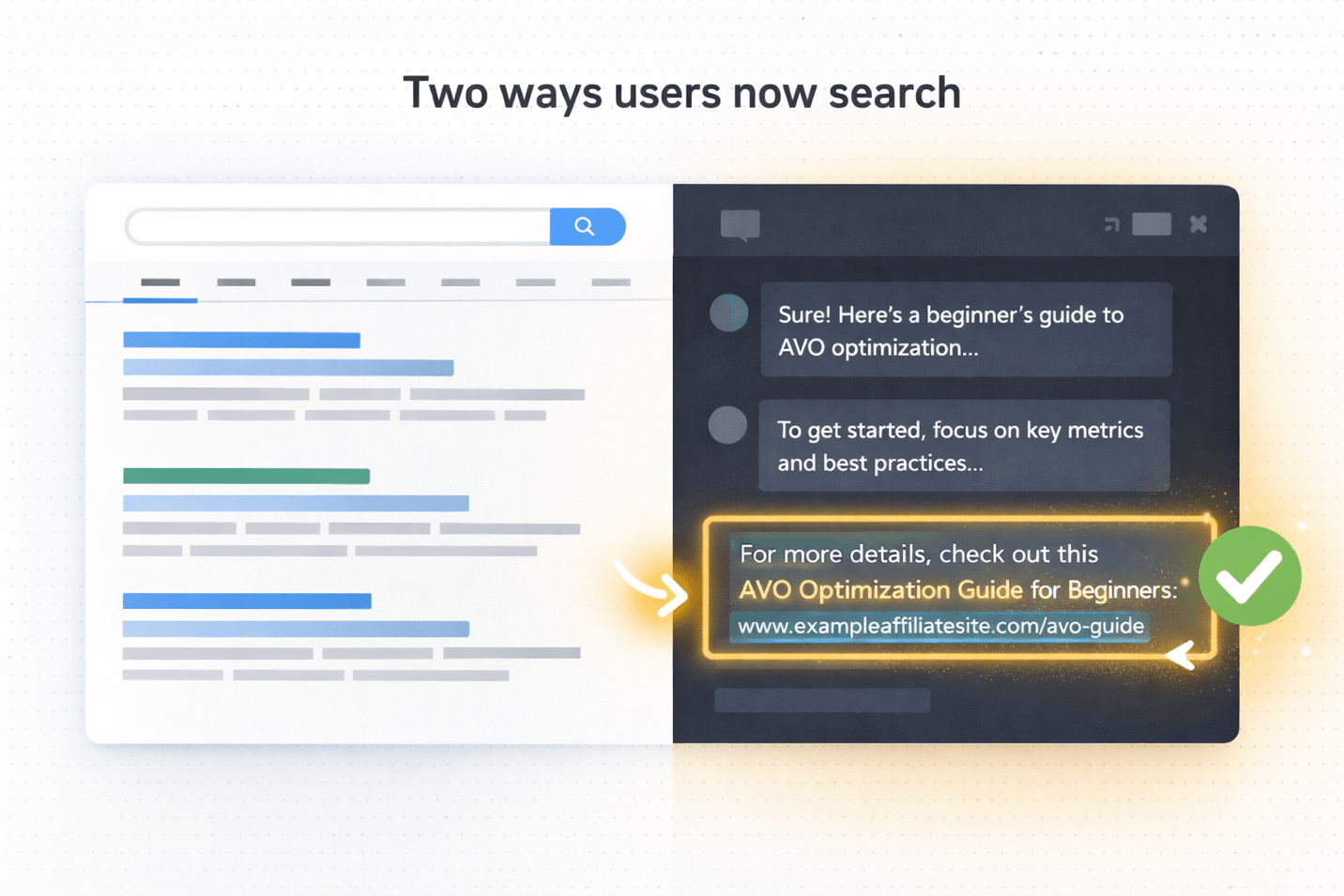
Caption: AI search vs traditional search — two ways users now find affiliate recommendations.
ChatGPT’s AI Mode crossed 75 million daily active users in March 2026. Perplexity has grown from a research curiosity to a mainstream search tool used by students, professionals, and shoppers. Google’s own AI Overviews now appear at the top of results for hundreds of millions of queries each month.
Affiliate marketing has always been a traffic arbitrage game — find where your audience is searching, put good content there, earn commissions. Your audience is now also searching in AI tools. The question is whether your site shows up when they do.
The affiliate sites building for AI readers today are quietly setting up to dominate 2027 — while their competitors are still debating whether AI search is real.
How AI Models Decide Which Sites to Recommend
This is the part most people get wrong. AI models do not work like search engines. They do not crawl your site and rank keywords. Instead, they have been trained on vast amounts of internet text and learn to associate certain sites and formats with credible, helpful answers. When someone asks a question, the model reaches for sources that pattern-match to trustworthy content on that topic.
Three signals matter most.
Clarity and structure
AI models are, at their core, text prediction systems. They favour content that is written in clear, direct, declarative sentences — not flowery prose, not keyword-stuffed paragraphs. Short paragraphs, specific answers, and well-labelled sections make it dramatically easier for an AI to extract a useful citation. If your content answers a question in the first sentence of a section, it is already doing better than most.
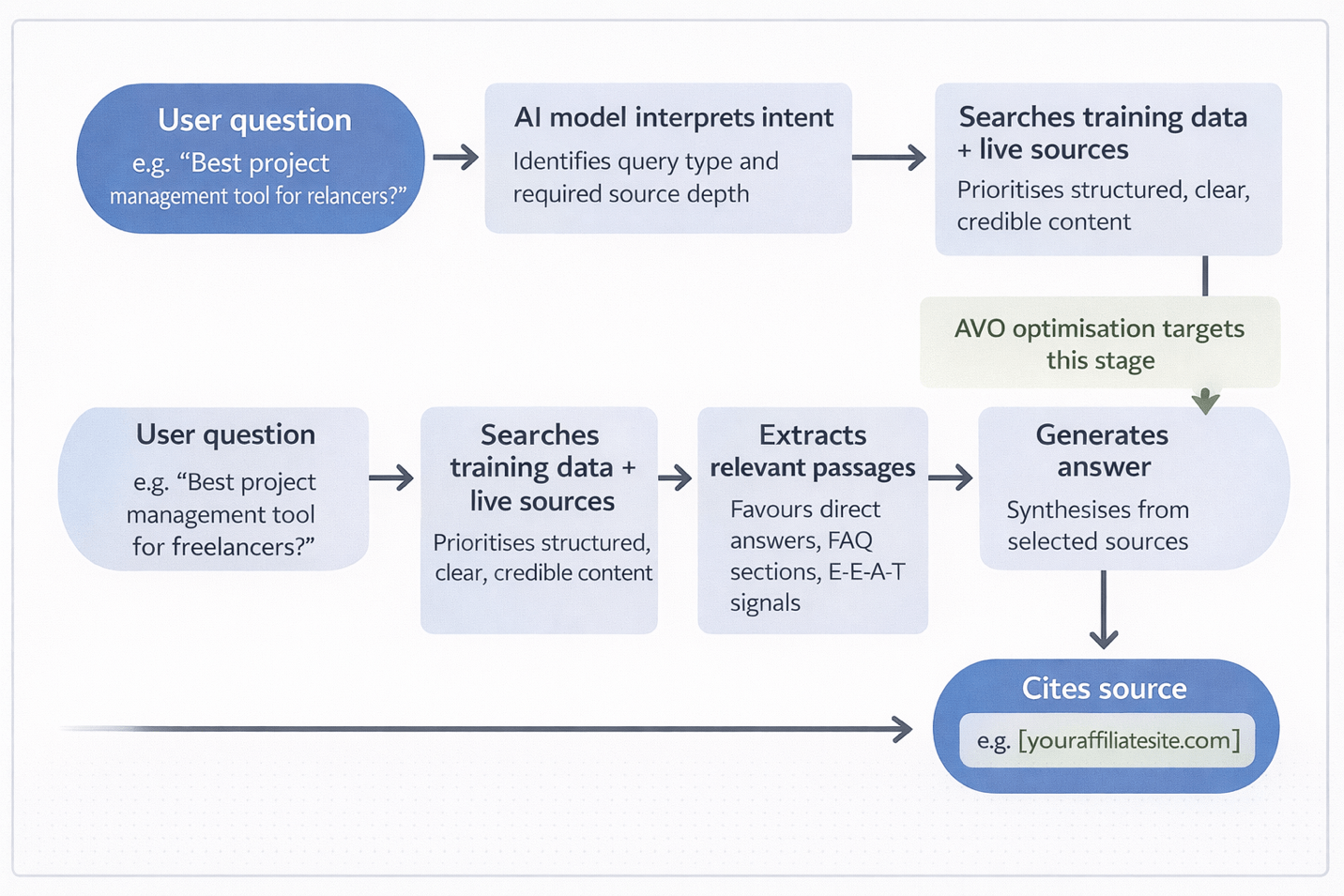 Caption: How ChatGPT and Perplexity decide which affiliate content to cite.
E-E-A-T signals
Google’s E-E-A-T framework — Experience, Expertise, Authoritativeness, Trustworthiness — has been a ranking factor for years. What most people do not realise is that AI models have essentially learned the same signals. A page with a clear author bio, first-hand product testing language, and specific verifiable claims is treated as more credible than a generic listicle.
When I tested Hostinger’s AI website builder, for example, I had a fully structured affiliate site published in under ten minutes — domain, hosting, homepage, and core pages, all set up through a guided AI interface. That kind of hands-on, specific claim is exactly what both Google and AI models reward. It signals that a real person did a real thing and reported it honestly.
An author bio, a disclosure, and one first-person anecdote do more for your AI search visibility than a month of backlink outreach.
Affiliate disclosures (yes, really)
Here is the counterintuitive finding that surprised even experienced affiliates: AI models, particularly ChatGPT, have been shown to identify sites with clear, prominent affiliate disclosures as more trustworthy sources — and to include them in answers more readily. The transparency that most beginners treat as a legal formality is actually a trust signal that AI systems actively look for.
The logic makes sense when you think about it. A site that tells its readers it earns commissions is being honest about its business model. That kind of transparency is a strong signal of editorial integrity.
Practical move: add a short, plain-English affiliate disclosure at the top of every post and on your About page. Not just for FTC compliance — for AI search credibility.
The Google vs. AI Search Comparison Every Affiliate Needs to See
The good news for affiliate site owners is that AVO and traditional SEO are not separate tracks. They share most of the same foundations. The table below shows where they overlap and where they diverge.
|
Factor |
Traditional Google SEO |
AI Search Optimisation (AVO) |
Overlap? |
|
Primary goal |
Rank in search results |
Get cited in AI answers |
High |
|
Key signals |
Backlinks, keywords, DA |
Structure, clarity, E-E-A-T |
Partial |
|
Content format |
Long-form keyword articles |
FAQ-rich, well-structured pages |
High |
|
Trust signals |
Domain authority, links |
Disclosures, author bios, citations |
Partial |
|
Speed to result |
3–6+ months |
Faster — weeks for established sites |
No |
|
Best tools |
Surfer SEO, Ahrefs, Frase |
Structured data, clear headers, FAQ schema |
Some |
Traditional Google SEO vs. AI search optimisation — where the signals align for affiliate sites.
The key takeaway from this table: if you are already building a legitimate affiliate site with real content and good structure, you are 70% of the way to AVO readiness. The remaining 30% is mostly formatting and schema work — things we will cover in the action plan below.
AVO is not a second job. It is what good affiliate SEO looks like when you account for where search is actually going.

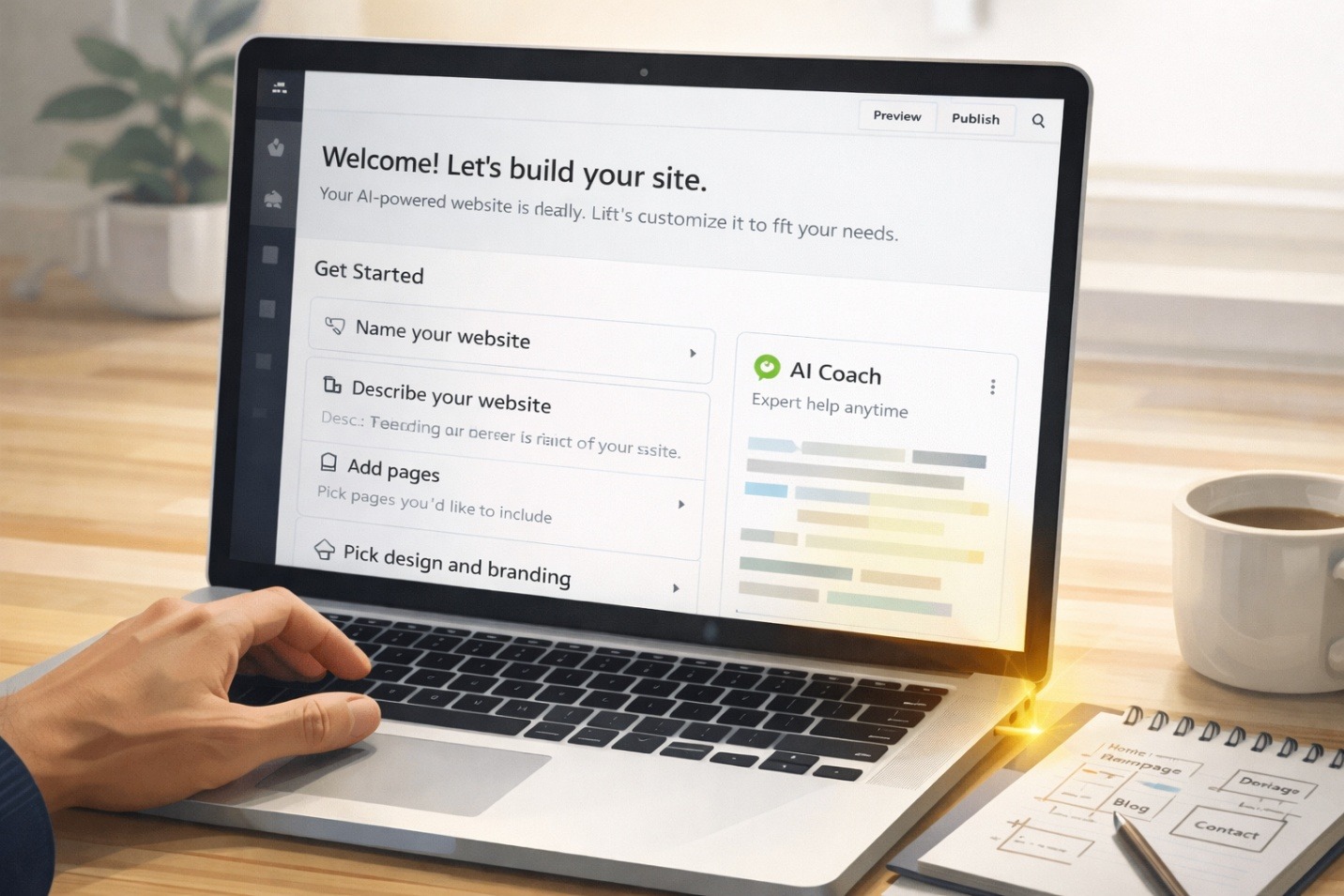
Caption: Hostinger’s AI builder makes setting up the technical foundation of an affiliate site accessible to complete beginners.
Your Five-Step AVO Action Plan for Affiliate Sites
AI Visibility Optimization – This is not a theoretical framework. These are the five specific things that have the biggest impact on whether AI models recommend your affiliate content, ordered by how quickly they take effect.
Step 1 — Restructure your content around direct answers
Take your most important affiliate posts and rewrite the opening of each major section to answer its implied question in the first one to two sentences. No build-up. No preamble. Just the answer, followed by your supporting explanation.
AI models extract passages, not entire articles. If the answer to ‘is Hostinger good for beginners?’ appears in your first sentence, the model can lift it cleanly. If it is buried in paragraph six after three paragraphs of context-setting, it probably will not be cited.
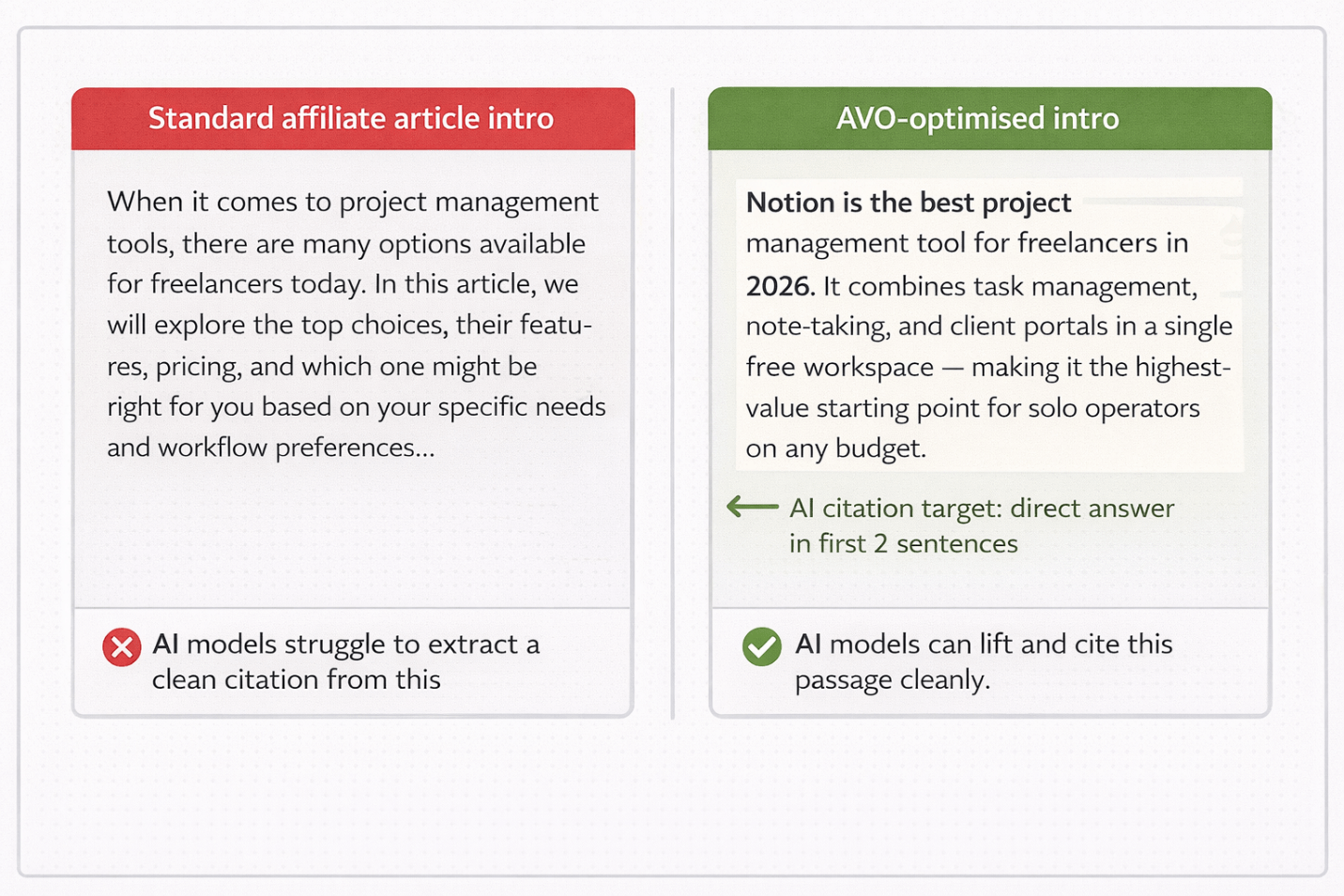
Caption: How restructuring content for direct answers increases AI citation likelihood.
Step 2 — Add FAQ sections to every major post
This single change delivers the highest AVO return for the least effort. A well-structured FAQ section does three things simultaneously: it targets Google’s People Also Ask boxes, it gives AI models pre-packaged answer blocks to lift verbatim, and it keeps human readers engaged.
Each FAQ answer should be 40 to 60 words — long enough to be a complete thought, short enough to be lifted cleanly as a citation. Use the exact phrasing of the question as the heading. This is not an accident — it is pattern-matching to how AI models search for source material.
Step 3 — Implement FAQ schema markup
Schema markup is the behind-the-scenes code that tells search engines and AI systems exactly what type of content each section is. FAQPage schema specifically tells Google and AI crawlers that these questions and answers are structured, reliable, and citable.
If you are on WordPress, the Rank Math or Yoast SEO plugins both add FAQ schema with a few clicks — no coding required. If you built your site with Hostinger’s AI builder, check the SEO section of the dashboard; structured data support is included in most modern AI-built site templates.
FAQ schema is the closest thing affiliate sites have to waving a flag at AI models that says: here, this is exactly what you need, formatted exactly the way you like it.
Step 4 — Strengthen your E-E-A-T signals
Add or update your author bio to include specific credentials, relevant tools you have personally used, and a photo. This takes twenty minutes and immediately increases the credibility signals AI models look for.
Beyond the bio, sprinkle first-person language naturally through your content. Phrases like ‘when I tested this tool’ or ‘in my experience with this platform’ are exactly the signals that distinguish your content from generic AI-generated text — and ironically, they are what makes your AI-assisted content more likely to be cited by other AI systems.
Caption: Adding a clear author bio and affiliate disclosure strengthens both Google E-E-A-T signals and AI search credibility.
Step 5 — Track your AI search visibility
You cannot improve what you cannot measure. Several tools now track how often your brand or content appears in AI model answers — including Semrush’s AI Overviews tracker, and dedicated AVO tools like Profound and Otterly.ai.
Start by searching your own site’s main topics in ChatGPT and Perplexity. Ask them the questions your best articles answer. If your site is not appearing, note which sites are — that is your displacement target.
[INTERNAL LINK: building an affiliate site with AI in 30 days — anchor text: real-world affiliate site experiment]
Run this search right now: ask ChatGPT the main question your best affiliate post answers. If your site does not appear, you just found your most urgent content priority.
The Steel-Man Case Against AVO (And Why It Still Matters)
Let’s be honest: some experienced affiliate marketers will push back on AVO, and their arguments deserve a fair hearing before we dismiss them.
The strongest version of the sceptic’s position goes like this: Google still drives the overwhelming majority of affiliate traffic. AI search citations are hard to measure, conversion rates from AI answers are unknown, and optimising for ChatGPT is like optimising for a platform that can change its behaviour overnight without warning. Why invest time in something unproven when organic Google traffic is still the engine that actually pays?
That is a legitimate point. And the honest answer is: do not abandon your Google strategy for AVO. Treat AVO as additive, not substitutional. Every change in the five-step action plan above also improves your Google rankings — clearer structure, better FAQ sections, stronger E-E-A-T signals. You are not doing extra work. You are making your existing work compound in an additional direction.
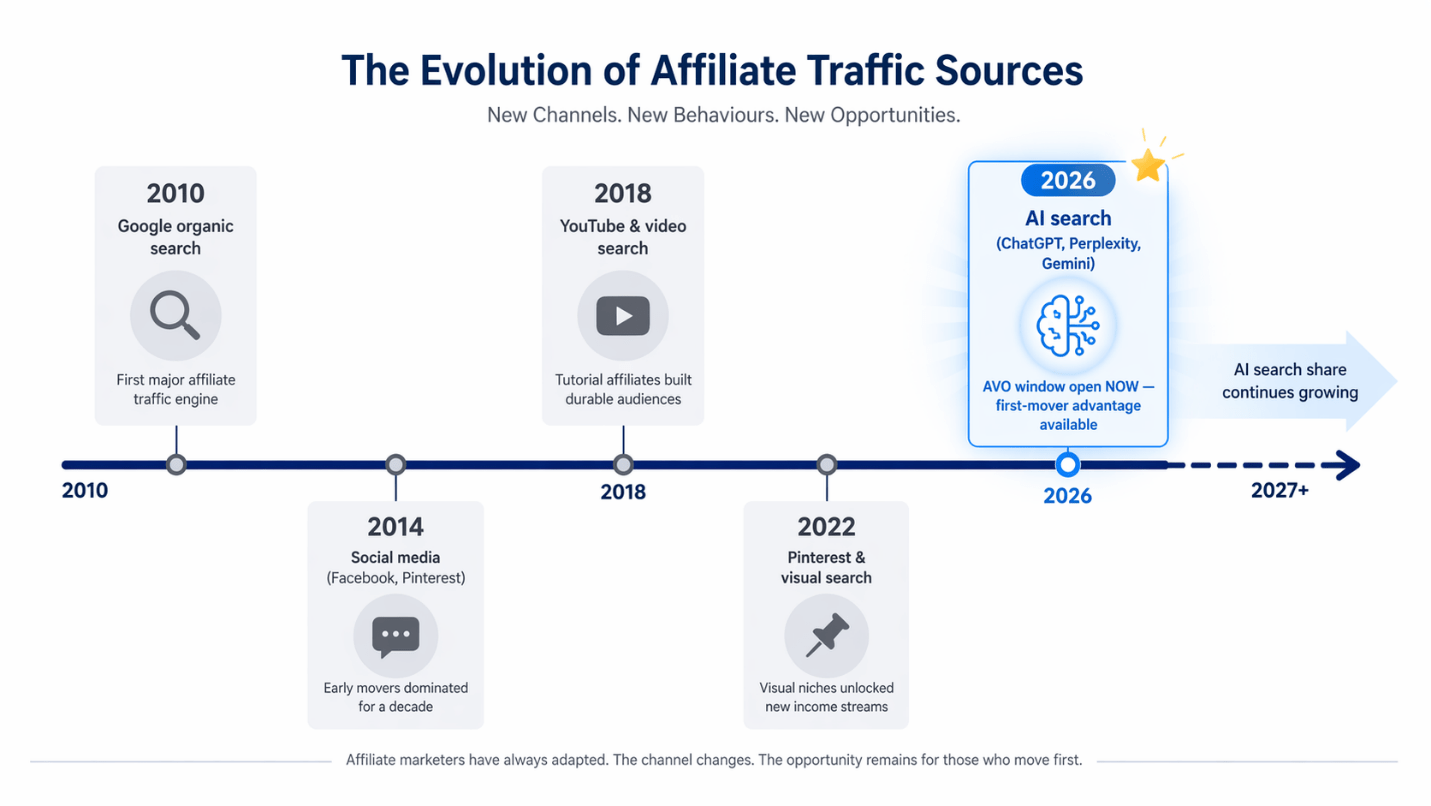
The deeper reason to care about AVO now specifically: first-mover advantage in a new traffic channel is extraordinarily valuable. The affiliates who built strong Google positions in 2015 compounded those gains for a decade. The window for the same play in AI search is open right now, and it will not stay open forever.
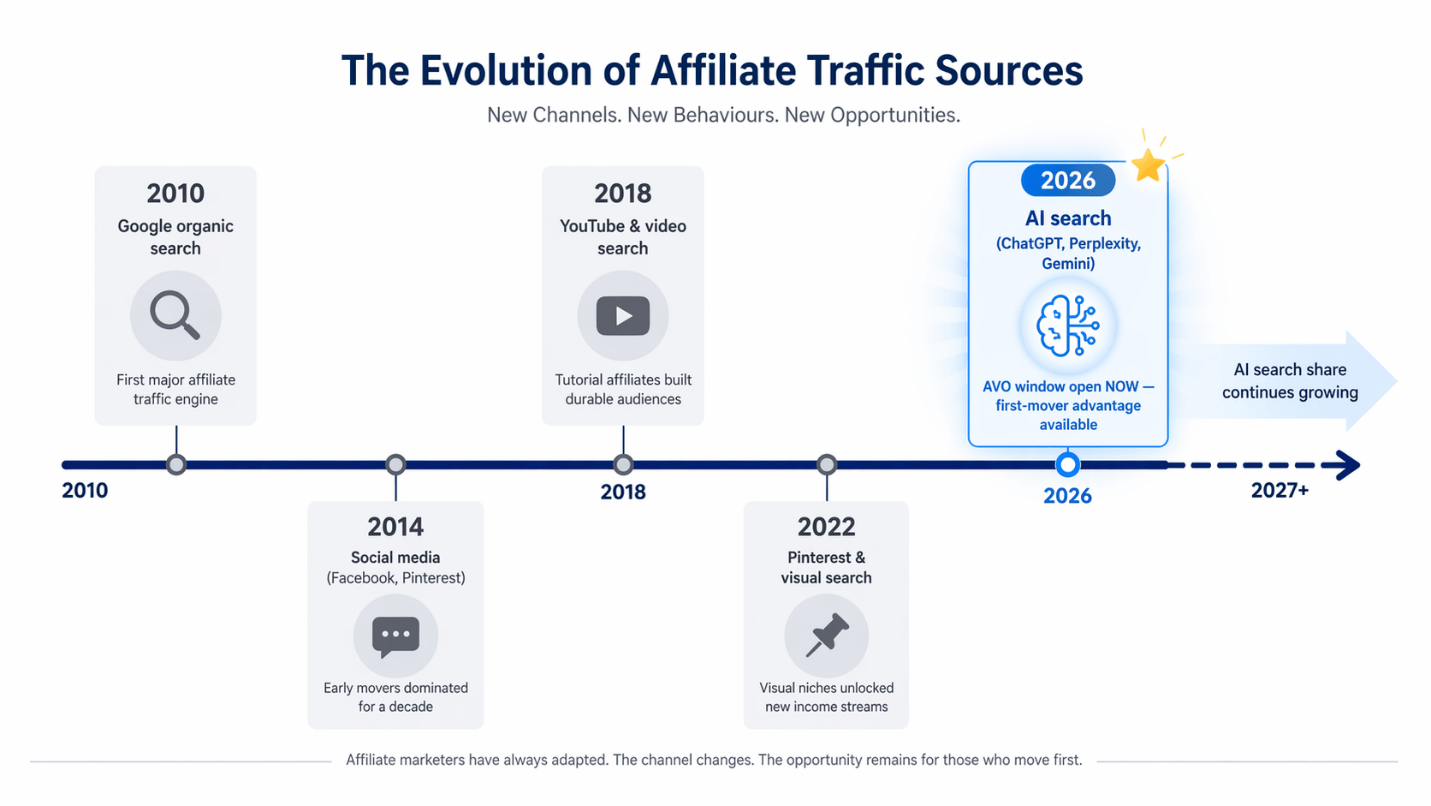 Caption: The history of affiliate traffic sources — AI search is the newest channel to optimise for.
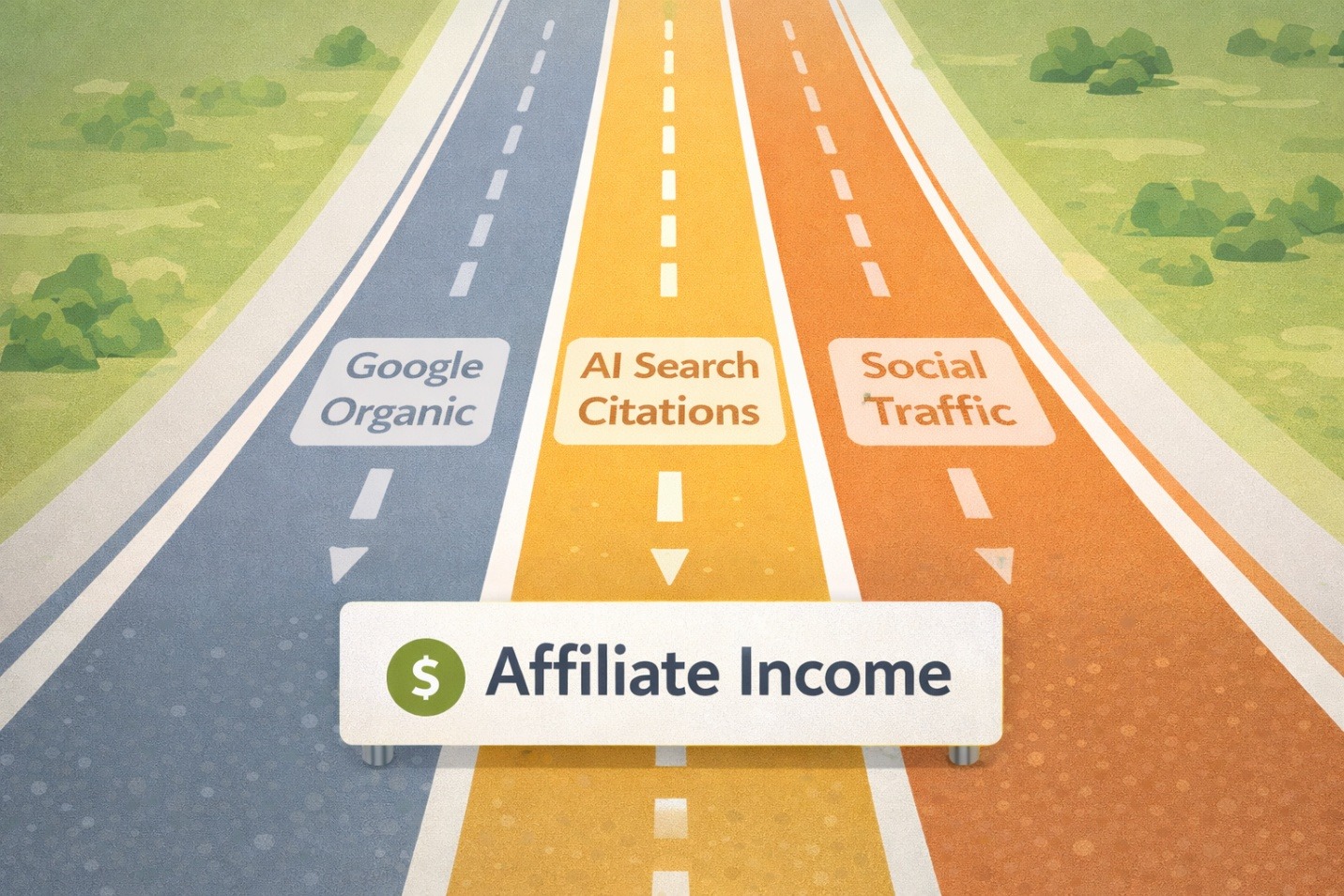
Caption: AI search is not a replacement for Google SEO — it is an additional lane to the same destination.
The affiliates who ignored social media in 2014 because ‘Google is still the main channel’ missed a decade of compounding traffic. History does not have to repeat.
Frequently Asked Questions
These are the questions most affiliate marketers ask when they first encounter AVO — answered directly, the way AI models like to find them.
How do I get my site to appear in AI answers?
Structure your content with direct-answer openings, add FAQ sections with 40–60 word answers to common questions, implement FAQPage schema markup, and strengthen your author bio and affiliate disclosures. AI models prioritise pages that are clear, structured, and demonstrate E-E-A-T signals. Applying these changes to your top five affiliate posts is the fastest starting point.
What is AI Visibility Optimisation (AVO)?
AVO — also called GEO, or Generative Engine Optimisation — is the practice of optimising your website content so that AI-powered tools like ChatGPT, Perplexity, and Google Gemini select it as a source when generating answers. It focuses on content clarity, structured formatting, schema markup, and trust signals like author credentials and affiliate disclosures.
Does ChatGPT actually recommend affiliate sites?
Yes. ChatGPT and other AI models recommend specific products, tools, and services in response to user questions — and they draw from real websites to do so. Sites with clear structures, strong E-E-A-T signals, and prominent affiliate disclosures are more likely to be cited. First-hand experience language and FAQ sections significantly increase citation likelihood.
How do I optimise content for Perplexity and ChatGPT?
Write in short, direct paragraphs. Answer questions in the first sentence of each section. Add an FAQ section to every major post. Use FAQPage schema markup. Include a detailed author bio with relevant experience. Add a clear affiliate disclosure at the top of each post. These five changes, applied to your existing content, represent the fastest path to AI search visibility.
What is GEO in SEO?
GEO stands for Generative Engine Optimisation — the practice of making your content more likely to be cited by AI-generated search tools like ChatGPT, Perplexity, and Google AI Overviews. Unlike traditional SEO which focuses on ranking in a list, GEO focuses on being selected as a trusted source for AI-generated answers. The two disciplines share most of the same best practices.
The Affiliate Site That Runs on Two Engines
There is a version of your affiliate site that gets traffic from Google rankings and AI citations simultaneously — two independent systems both sending readers to your content and your affiliate links, 24 hours a day, without you actively working either channel.
That is not a fantasy. It is the practical result of building your site correctly: clear structure, direct answers, strong E-E-A-T signals, FAQ sections, and affiliate disclosures you stopped being embarrassed about.
[INTERNAL LINK: The AI content pipeline that runs your affiliate site while you sleep — anchor text: building your automated content pipeline]
The five steps in this guide are not a reinvention of your content strategy. They are the same disciplines that have always separated high-performing affiliate sites from mediocre ones — just now applied to a new surface where your competitors are not yet showing up.
Think about the last time you discovered a tool or strategy before everyone else in your niche. What did it feel like to move fast on it? This is one of those moments.
You do not need a new site, a bigger budget, or a different niche. You need your existing content to work harder — and now you know exactly how to make it do that.
To rank affiliate content in AI search, you do not need to start from scratch. Start with your best post. Add a FAQ section. Check your author bio. Add a clear disclosure. Then search for your main question in ChatGPT and see what comes back.
The gap between where your site is now and where it could be in AI search results is mostly an afternoon of focused work — and a small shift in how you think about what your content is for.
Where to go from here:
Now that you understand how AI search selects affiliate content, the natural next step is seeing how this fits into a full automated content system — one where keyword research, drafting, optimisation, and publishing all flow together without you managing each piece manually.
Read next: The AI Content Pipeline That Runs My Affiliate Site While I Sleep
Every week you wait is a week your competitors could be appearing in AI answers instead of you. Start with one post. See what changes.